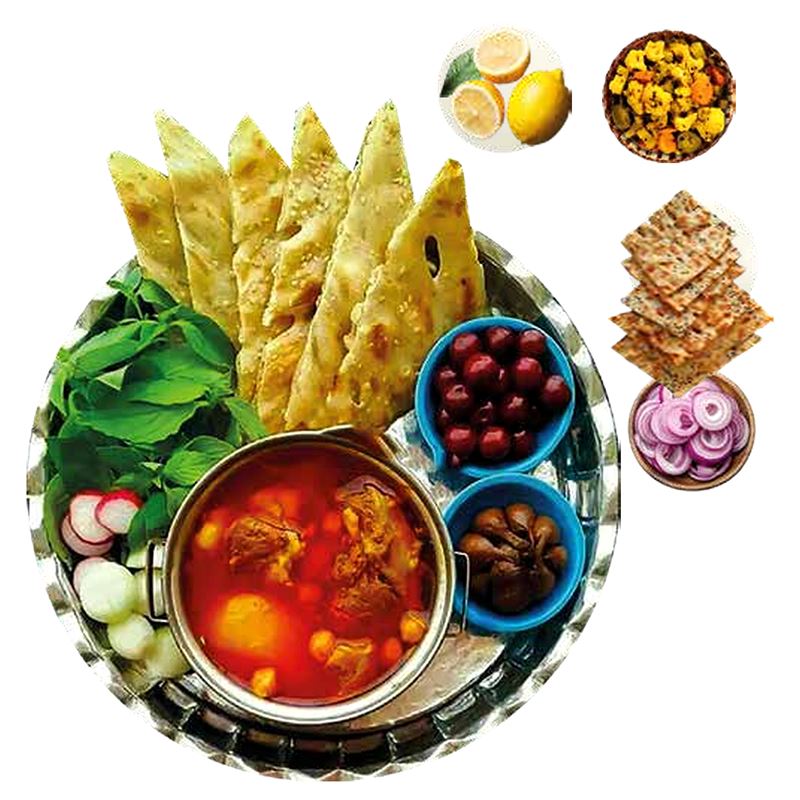
What is tas kabab, and why is it not a grilled kabab?
Tas kabab (Persian: تاسکباب) is one of the gentlest, most forgiving dishes in the Iranian home kitchen. The name puzzles many first-timers: tas means a shallow bowl or metal basin, and the dish takes its name from the pot it was traditionally steamed in, not from any skewer or grill. There is no charcoal and no koobideh here. Instead, thin layers of onion, meat, potato, carrot, tomato and fruit are stacked in a heavy pot and cooked slowly over low heat until every layer softens and the flavours melt into one another. The result is meltingly tender, faintly sweet and sour, and deeply comforting.
This is a home recipe written for cooks in Dubai who want to make it properly. It is not on our menu, so treat this as your weekend project.
What ingredients do you need for tas kabab?
These quantities serve about four people. Slice everything thinly and evenly so the layers cook at the same speed.
- 600 g lamb shoulder or stewing beef, cut into thin, palm-sized slices or small pieces
- 2 large onions, peeled and very thinly sliced
- 3 medium potatoes, peeled and sliced about 0.5 cm thick
- 2 carrots, sliced into thin rounds
- 2 ripe tomatoes, sliced
- 1 quince (or 1 tart apple), cored and sliced
- 1 small eggplant, sliced and lightly salted (optional)
- 6–8 pitted prunes or dried plums (optional, for a sweeter note)
- 1 tablespoon tomato paste (optional, for colour and depth)
- ½ teaspoon ground turmeric
- ¼ teaspoon ground cinnamon
- ¼ teaspoon ground saffron, bloomed in 3 tablespoons hot water
- 1–2 tablespoons grape molasses (shireh angoor), or the juice of 1 lime / 1 dried lime, pierced
- 3 tablespoons oil or butter
- Salt and black pepper to taste
- About 120 ml water or light broth
Which meat and fruit are best?
Lamb shoulder is the classic choice because its fat keeps the dish moist, but boneless stewing beef works beautifully too. Avoid very lean cuts, which turn dry. Quince gives the most authentic, perfumed sweet-sour edge; if you cannot find it in Dubai, a firm tart apple is the accepted substitute. Prunes are optional but traditional in many Tehran households.
How do you make tas kabab step by step?
- Bloom the saffron: stir ground saffron into 3 tablespoons of hot (not boiling) water and set aside.
- If using eggplant, salt the slices and rest for 20 minutes, then pat dry to remove any bitterness.
- Choose a heavy, wide pot with a tight lid. Pour in the oil, then lay down half the onion slices as the bottom cushion — this protects the layers from scorching.
- Season the meat with turmeric, cinnamon, salt and pepper. Lay half the meat over the onions.
- Build the layers in order: potatoes, carrots, remaining onion, remaining meat, tomatoes, quince (and eggplant and prunes if using). Season lightly between the layers.
- Dot the tomato paste over the top, then drizzle over the saffron water, the grape molasses (or lime), and pour the water or broth in around the edge. Do not fill the pot with liquid — the dish steams, it does not boil.
- Cover tightly and cook on the lowest heat for 1½ to 2 hours. Do not stir. Once or twice, gently shake the pot or tilt it to spoon the juices back over the top.
- It is ready when the potatoes are fork-tender, the meat pulls apart easily, and the liquid has reduced to a glossy, spoonable sauce. Rest for 10 minutes before serving.
What are the most common mistakes?
| Mistake | What happens | Fix |
|---|---|---|
| Too much water | You get soup, not a layered stew | Add only a splash; let it steam |
| Stirring the pot | Layers collapse into mush | Never stir; only shake gently |
| Heat too high | The base scorches, the top stays raw | Lowest flame, tight lid, be patient |
| Lean meat | Dry, stringy result | Use lamb shoulder or fatty stewing beef |
| Uneven slices | Some layers raw, some overcooked | Slice thin and even, about 0.5 cm |
How is tas kabab traditionally served?
Serve it warm, straight from the pot, with warm sangak or barbari bread to scoop up the sauce, or over a plate of fluffy Persian rice. A dish of Persian torshi pickles cuts the sweetness, and a cold glass of doogh balances the richness. If you would rather serve it with rice, our guide to fluffy chelo rice pairs perfectly.
Is tas kabab a healthy meal?
As a one-pot dish it brings together protein from the meat and a good amount of vegetables in a single serving, which many families find satisfying and balanced. This is general information, not medical advice; for guidance about your own diet, please consult a doctor or a registered dietitian.
Would you rather not cook today?
Tas kabab is a labour of patience, and some nights you simply want a hot, home-style meal without the two-hour wait. We do not cook tas kabab, but if you are craving authentic Tehran-style comfort food, our kitchen at 64 Jumeira Street serves kalle pache and fresh sangak around the clock, with delivery across Dubai, pickup, and dine-in reservations. Delivery is free over AED 300, and the delivery fee is shown by area at checkout.
