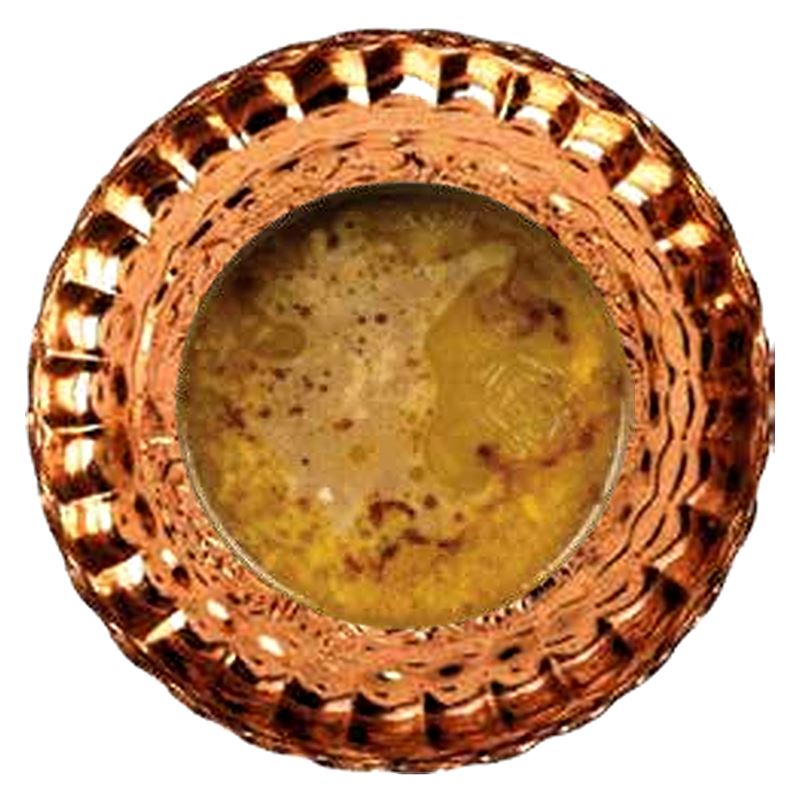
What is ash-e anar?
Ash-e anar (Persian «آش انار», literally «pomegranate soup») is a thick, ruby-red, sweet-and-sour herb soup from the north of Iran, where pomegranates hang heavy on the trees of Gilan and Mazandaran. It belongs to the huge family of Persian ash — spoonable herb soups that are a meal in themselves — and this one is defined by two things: a deep tang of fresh pomegranate juice, and a generous, almost reckless amount of green herbs. A little rice and some yellow split peas melt down to give the body, tiny meatballs called koofteh bob through it (optional but traditional), and the bowl is finished with a swirl of fried mint and a scatter of glittering pomegranate arils. The result is tart, herby and gently sweet all at once — a soup that tastes like a cold, bright winter day.
Why is ash-e anar a Yalda soup?
Ash-e anar is most loved at Yalda, the night of the winter solstice, when Iranian families stay up together to welcome the return of longer days. Red foods rule that table — watermelon, pomegranates, and dishes coloured deep crimson — and a pot of pomegranate soup fits perfectly. Pomegranate has been prized in Iran for a very long time as a nourishing, warming fruit, and a bowl of this soup is part of the comfort and ritual of the longest night. That is a matter of tradition and taste, not a health claim: this is general information, not medical advice, so please check with a doctor or dietitian for anything to do with your own diet.
What ingredients do you need for ash-e anar?
This makes a generous pot for about six people. The quantities are a starting point — the soul of the dish is tasting and adjusting at the end.
- 1/2 cup (100 g) yellow split peas (lapeh), soaked 1 hour
- 1/3 cup (70 g) rice, rinsed
- 2 large onions (one for the soup, one grated for the meatballs)
- 3 cups (about 750 ml) fresh pomegranate juice, from 6–8 pomegranates, or unsweetened 100% bottled juice
- 2–3 tablespoons pomegranate paste (rob-e anar), to taste
- 1–2 tablespoons sugar, to balance
- 1 large bunch parsley (about 200 g), finely chopped
- 1 large bunch coriander/cilantro (about 150 g), finely chopped
- 1 bunch spring onions (about 100 g), chopped
- 2 tablespoons dried mint, plus more for the garnish
- 1/2 teaspoon turmeric, plus oil, salt and black pepper
- For the koofteh (optional): 250 g minced beef or lamb, 1 grated onion squeezed dry, 1/2 teaspoon turmeric, salt and pepper
- For the fried mint (na'na dagh): 3 tablespoons oil and 2 tablespoons dried mint
- To garnish: fresh pomegranate arils, fried mint, and optional fried garlic or onion
How do you make ash-e anar step by step?
Give yourself about an hour of gentle simmering after the soak, and keep a kettle of hot water nearby to loosen the soup as it thickens.
- Drain the soaked split peas. In a large pot, soften one chopped onion in 3 tablespoons oil over medium heat until golden, 8–10 minutes, then stir in the turmeric.
- Add the split peas and about 6 cups (1.5 litres) water. Bring to the boil, then simmer for 20 minutes, until the peas start to soften.
- Add the rinsed rice and simmer another 20–25 minutes, stirring now and then and topping up with hot water, until the rice breaks down and thickens the soup.
- Stir in the chopped parsley, coriander, spring onions and dried mint. Simmer uncovered for 25–30 minutes, until the herbs darken and the soup turns green-brown and glossy.
- Lower the heat and stir in the pomegranate juice and 2 tablespoons of pomegranate paste. Keep it at a gentle simmer, never a hard boil, for 15–20 minutes so the flavours marry.
- Now taste and balance (see the table below), adding sugar, more paste and salt until the sweet-and-sour is exactly right.
- Fry the mint: heat the oil, take it off the heat, and stir in the dried mint for just a few seconds until fragrant — never let it blacken. Swirl half into the soup and keep the rest for the top.
- Ladle into bowls and finish each one with fried mint and a handful of fresh pomegranate arils.
Doneness cue: the soup should be thick enough to coat the back of a spoon but still easily pourable, with a deep burgundy colour. If it stiffens as it sits, loosen it with a little hot water before serving.
How do you make the koofteh (little meatballs)?
If you want the meatball version, mix the minced meat with the grated, squeezed onion, turmeric, salt and pepper, and knead for a minute so it holds together. Roll tiny marble-sized balls — they should be small, not kofta-sized — and drop them gently into the soup after the rice stage, letting them poach for about 15 minutes before you add the herbs. For a vegetarian pot, simply leave them out; the soup is complete without them. If you want to go the other way entirely, kufteh Tabrizi is the giant stuffed version, one meatball to a bowl, poached in its own saffron broth.
How do you balance the sweet-and-sour?
This is the whole art of ash-e anar. Pomegranates vary wildly, so never trust the recipe over your own tongue. Add the juice and paste near the end, taste, and nudge it in small steps.
| If it tastes… | Likely cause | Fix |
|---|---|---|
| Too sour or sharp | Very tart juice or too much paste | Add sugar a little at a time, plus a splash of hot water |
| Too sweet or flat | Too much sugar, weak juice | Stir in more pomegranate paste and a pinch of salt |
| Too thin | Rice and peas not cooked down enough | Simmer longer, or add a spoon of rice |
| Too thick or heavy | Reduced too far | Loosen with hot water |
| Dull or brownish, not red | Boiled hard after the juice went in | Keep a gentle simmer; a spoon of paste lifts the colour |
What are the most common mistakes?
A few small habits separate a bright, ruby ash from a muddy one. Add the pomegranate juice at the end, not the start, and never let it boil hard — a rolling boil dulls the colour and can turn the tang bitter. Use unsweetened juice; sweetened juice or grenadine syrup will wreck the balance. Be generous with the herbs, because they are the backbone of any ash; a timid handful gives a thin, one-note soup. Watch the fried mint like a hawk — off the heat, a few seconds only, or it turns bitter. And above all, taste at the end: the sweet-sour balance is the point of the dish, and it is the last five minutes that make it. If you love this kind of tangy, herb-heavy cooking, you might also enjoy our guide to Persian food beyond kalle pache, and a jar of homemade Persian torshi pickles alongside is never a bad idea.
Can you order instead of cooking?
Ash-e anar is a home dish, and to be honest we do not cook it — we are a kalle pache house, not a soup kitchen, and we would never pretend otherwise. But if an afternoon over a pot of pomegranate soup is not how your day is going, we are here around the clock. At Shaun the Sheep — one kitchen at 64 Jumeira Street, Jumeirah 1 — we simmer Tehran-style kalle pache 24 hours a day and deliver right across Dubai, with delivery free over AED 300 and the fee for your area shown at checkout. Browse the full spread on our menu and order page, or reserve a table to sit down with sangak, torshi and a cold doogh. Cook the ash for Yalda, and let us handle the kalle pache.
