Are Persian and Arabic cuisine the same thing?
They are neighbours, not rivals — and in Dubai, Persian and Arabic cuisine sit at the same table every day. Both grew up around the same warm sea, traded the same spices along the same caravan and dhow routes, and share the same deep instinct for hospitality, where the measure of a good host is a table too full to finish. But they are not one cuisine. Persian food tends to whisper — layered, herb-heavy, gently sweet-and-sour. Gulf Arabic food tends to sing — warm, boldly spiced, built around one generous pot of rice and meat. Loving one has never meant choosing against the other, and this article is a celebration of both, not a ranking.
How do Persian and Arabic cooks treat rice differently?
Rice is where the two philosophies show themselves most clearly. In the Persian kitchen, rice is cooked in two stages: long-grain rice is parboiled, drained, then steamed slowly so every grain stays separate and a golden crust — tahdig — forms at the bottom of the pot. Plain steamed rice is chelow; rice folded through herbs, beans or barberries is polow. Saffron is bloomed and drizzled on top like a crown. The rice is a component, served beside the stew or kebab, never mixed into it.
Gulf Arabic cooking takes the opposite, gloriously communal route: one pot. In kabsa, machboos and mandi, the rice cooks inside the spiced meat broth so it drinks up every bit of flavour, then the whole thing is piled onto a shared platter with the meat resting on top. Mandi even borrows smoke from a pit oven. One tradition keeps the elements apart and lets you assemble each bite; the other marries them in the pot. Both end in the same place — a mountain of fragrant rice meant to be shared.
Where does the sourness come from in each cuisine?
Both cuisines love a bright, sour edge, but they reach for it differently — and this is where they secretly meet. Persian cooking builds sourness with dried lime (limoo omani), fresh lime, sumac dusted over grilled meat, pomegranate molasses, and even verjuice from unripe grapes. Here is the lovely part: that dried lime is called limoo omani — Omani lime — after the Gulf trade that carried it north, and in Arabic kitchens the very same black lime is loomi or noomi basra. It seasons an Iranian ghormeh sabzi and an Emirati machboos alike. Sumac, too, belongs to both tables. So while Persian sourness leans herbal and tangy and Gulf sourness leans warm and smoky, they are drawing from the same pantry far more often than either side realises.
Herbs versus spice blends: what defines the flavour of each?
If you had to name the signature of each cuisine in one breath: Persian food is herb-led, Gulf Arabic food is spice-led. A Persian table almost always carries sabzi khordan, a plate of raw herbs — mint, tarragon, basil, radish — eaten alongside the meal, and stews like ghormeh sabzi are built on kilos of finely chopped parsley, coriander and fenugreek. The spicing is subtle: saffron, turmeric, cinnamon, rose and a soft blend called advieh. Gulf cooking, by contrast, is defined by its warm spice blends — baharat and the Emirati bezar — layering black pepper, cumin, coriander, cardamom, cloves, cinnamon and dried lime into a deep, aromatic heat. Neither is fiery in the chilli sense; both are aromatic. One perfumes with greenery, the other with toasted seed and bark.
Do both cuisines prefer grilling or slow cooking?
Happily, both do both. Persian cuisine is famous for the kabab — koobideh, barg, saffron joojeh — grilled fast over charcoal, yet its soul lives in the slow khoresh, stews like fesenjan (walnut and pomegranate) that simmer for hours. Gulf Arabic cuisine has its own live-fire tradition in mashawi grills and shawarma, alongside slow, patient dishes: harees, wheat and meat pounded to a silky porridge over many hours, and mandi and madfoon, cooked low in a sealed pit. The shared truth is that both cultures treat long, slow cooking as an act of care — food that takes all night is food made for people you love. That is exactly the philosophy behind a pot of kalle pache.
What is the quick comparison between Persian and Arabic cuisine?
| Feature | Persian cuisine | Gulf Arabic cuisine |
|---|---|---|
| Rice method | Two stages: parboiled then steamed; crispy tahdig | One pot; rice cooked in the meat broth |
| Rice served | Beside the dish (chelow / polow) | Under the meat on one platter (kabsa, machboos, mandi) |
| Signature flavour | Fresh herbs, gentle sweet-and-sour | Warm spice blends (baharat, bezar) |
| Souring agents | Dried lime, sumac, pomegranate, verjuice | Dried lime (loomi), lemon, sumac |
| Key spices | Saffron, turmeric, cinnamon, advieh | Cardamom, cumin, coriander, cloves, saffron |
| Grilling | Kabab (koobideh, barg, joojeh) | Mashawi, shawarma |
| Slow cooking | Khoresh stews, kalle pache | Harees, mandi, madfoon, pacha |
| Shared meeting point | Kalle pache / dried lime / sumac | Pacha / loomi / sumac |
Which dishes do Persians and Arabs actually share?
More than either might guess. The dried-lime-and-rice DNA runs through both. Grilled skewers are common ground. Saffron, cardamom, rosewater and sumac cross every border in the region. Sweet pastries scented with rose and pistachio appear from Shiraz to Sharjah. And then there is the dish that belongs to everyone at once — the one simmered from a lamb's head and trotters overnight.
Why is kalle pache the meeting point of both traditions?
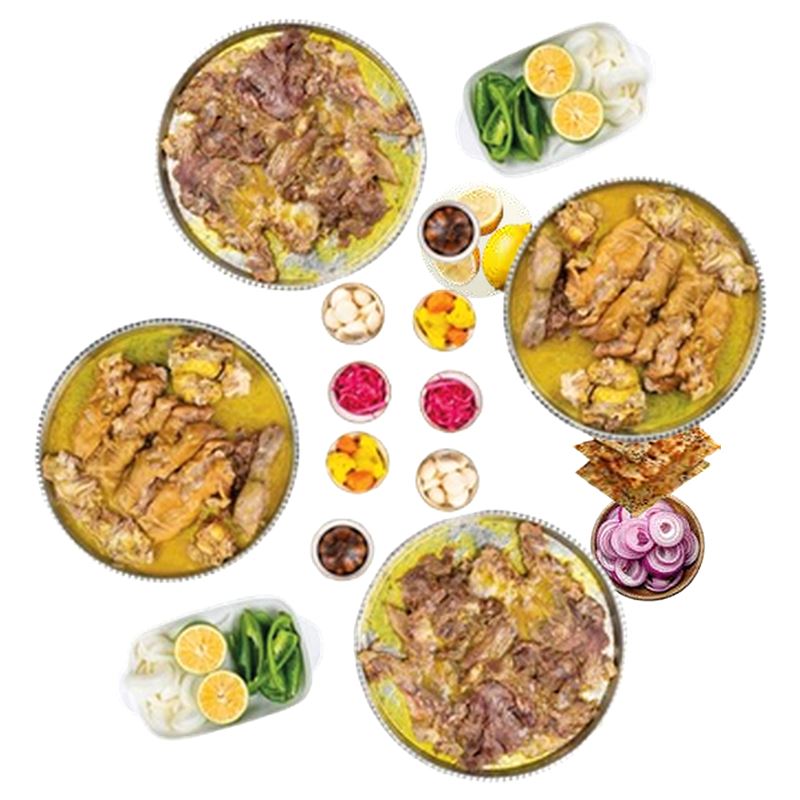
If Persian and Arabic cuisine shake hands anywhere, it is over a bowl of head-and-trotter broth at dawn. Iran calls it kalle pache; Iraq and the Gulf call it pacha (also baja) — and the word itself is Persian, pa-cheh, little foot, borrowed across the region centuries ago. The dish is the same idea everywhere it appears: the humblest cuts of the lamb, nothing wasted, cleaned by hand and simmered all night into a rich broth eaten in the early morning with bread. Iraqis serve their pacha over torn bread as tashreeb; Iranians tear sangak into the bowl. It is nose-to-tail cooking that both peoples have kept alive without needing anyone to rediscover it. At Shaun the Sheep the heads and trotters are hand-cleaned before dawn and simmered for around fourteen hours in a copper pot with onion, turmeric and garlic, skimmed hour after hour until the broth turns the colour of strong tea. Whichever tradition raised you, this bowl will feel like home.
If you love both cuisines, what should you order in Dubai?
Start with a communal platter — sized for one, two, three or six people — which fits the shared-table instinct both cuisines share. If you want to explore piece by piece, order singles: brain (maghz), tongue (zaban), trotters (paye), lamb cheek (bonagoosh), meat, tripe (sirabi) or the Special Mix. There is a slow-cooked abgoosht (dizi) for anyone who prefers a hearty stew, and the sides tell the shared story: sangak bread, mixed torshi, seven-year garlic pickle, and cold doogh to drink. Browse everything on the menu and order page.
Where can you eat Tehran-style kalle pache in Dubai?
Shaun the Sheep is a single Tehran-style kitchen at 64 Jumeira Street, Jumeirah 1 — not a chain, one kitchen that delivers city-wide. We are open 24 hours a day, seven days a week, our lamb is halal in line with UAE law and standards, and we deliver to all of Dubai with the fee shown by area at checkout before you pay (free over AED 300). Pickup and dine-in are available, and you can schedule an order for a future time. Explore the menu and order page, or reserve a table if you are bringing the whole family for the full platter. This article celebrates culinary tradition and is not medical or dietary advice; if a health condition affects how you eat rich or fatty foods, please speak to your doctor.
