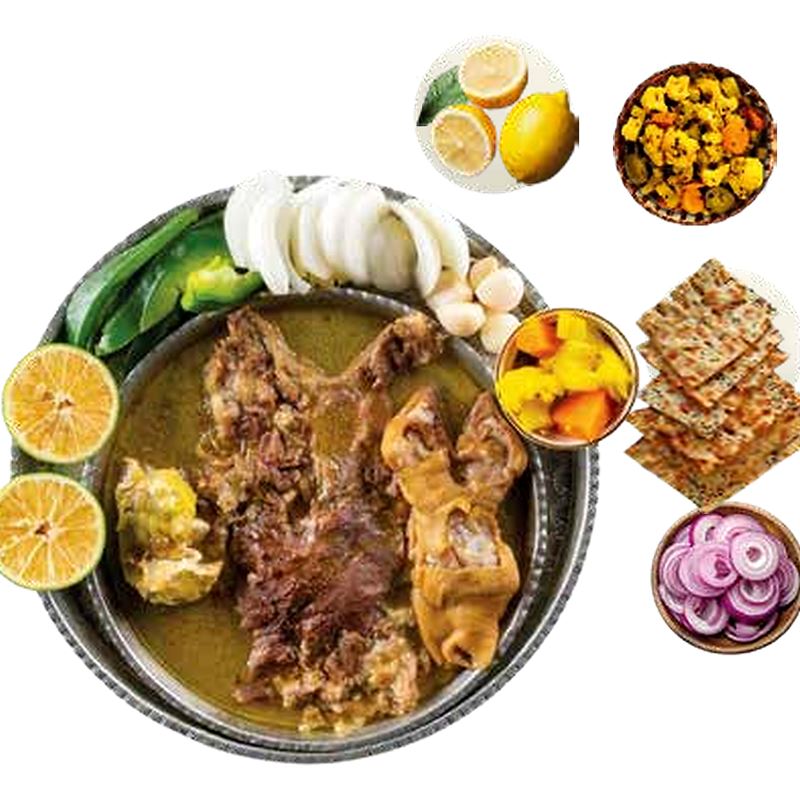
Short answer: the Western breakfast most of us default to in Dubai is sweet, fast and individual — coffee, eggs, toast or something baked, eaten in fifteen minutes on the way to somewhere else. The traditional Persian breakfast is close to its opposite: savoury, slow and shared — a bowl of hot broth, bread torn by hand at the table, sharp pickles, and tea that keeps arriving. Neither one is better. They were built for different kinds of morning.
This is a comparison, not a contest: most people here eat both in the same week.
What is actually on a Persian breakfast table?
Strip away the romance and a short, repeating list remains — every item with a job.
- Broth, first. The Soup — the abgoosht broth straight from the pot — comes hot and thin enough to drink. It arrives before anything heavy and opens the appetite rather than closing it.
- Bread as a tool, not a side. Sangak is flat and blistered and built to be torn. You tear it, dip it, wrap with it, and use it where a Western table would reach for a fork. Special Sangak is the same idea, dressed up — and extra sangak is an add-on for a simple reason: the table always wants more.
- One rich thing in the middle. A single, by the bowl: Meat (goosht), Lamb Cheek (bonagoosh), Tongue (zaban), Trotters (pacheh), Brain (maghz), Brain Soup, Eye (cheshm), Tripe (sirabi) — or Special Mix (mojoon), which is a little of everything.
- Something sharp to cut through it. Mixed Torshi, or Garlic Torshi for people who mean it. Acidity is not decoration here; it is the balance that lets you keep eating something this rich.
- Something to drink slowly. Tea or black tea, and — dining in — a whole Kettle of Tea for the table. Doogh if you want salt and coolness instead of sweetness. Fresh lemonade, water or a soft drink if you don't.
If the dish itself is new to you, read what kalle pache actually is first, then come back here.
Why is one sweet and fast, and the other savoury and slow?
The Western breakfast we know today is shaped by the clock. It has to be portable, quick and easy to eat alone: sugar and caffeine for a fast start, one plate per person, almost nothing to wash up. That is not a criticism: it is an excellent answer to a real problem — twenty minutes and a commute.
The Persian breakfast answers a different problem. The pot is a long, patient simmer, so it is ready in the small hours rather than at nine. It was traditionally eaten early, before a physically demanding day, and eaten in company: you sat down, tore bread, talked, and stayed where you were for a while. It is filling the way a proper meal is filling, and it quietly assumes you have somewhere comfortable to be afterwards.
Western breakfast vs Persian breakfast: an honest comparison
| Dimension | Western breakfast | Persian breakfast |
|---|---|---|
| Typical timing | Roughly 7–10am, squeezed into the commute | Dawn to mid-morning, because the pot has simmered overnight |
| Dominant flavour | Sweet, buttery, roasted | Savoury and deep: broth, salt, garlic, sour pickle |
| Texture | Crisp and dry — you chew | Soft, silky, warm — you sip, tear and scoop |
| What you drink | Coffee or juice | Tea, black tea, or a kettle for the table; doogh; fresh lemonade |
| How it is served | One plate per person | Shared bowls and bread in the middle; everyone reaches in |
| Pace | Fifteen minutes, often standing | An hour, and nobody is counting |
| How full you feel after | Comfortable; hungry again by eleven | Deeply full; most people skip lunch |
| Effort to make at home | Low | High — the overnight simmer is why most people order it |
| Best for | Workdays, early meetings, eating alone | Weekends, guests, cold mornings, after a night shift, a table of six |
Which one suits which morning?
Alarm at six, meeting at eight, laptop bag by the door: the Western breakfast wins on logistics alone, and pretending otherwise would be silly.
The Persian breakfast is for the other mornings. A Friday with the family. The end of a night shift, when your body wants a real meal and the world is serving pastries. A cold, damp morning. Relatives visiting, and a table that needs to be generous. And the appetite that turns up at four in the morning and flatly refuses toast — which is exactly why the kitchen runs 24 hours.
You grew up on eggs and toast. How should you approach a first kalle pache?
Gently, and in this order.
- Start with broth and bread. Order the Soup with Sangak and a Torshi. On its own that is already a complete breakfast, and it teaches you the flavour before it introduces the textures.
- Add exactly one single. Not four. A crowded first table is overwhelming, and the singles are generous.
- Choose that single by texture, not by bravery. The table below is the honest map.
- Eat it hot, and eat it with bread. Broth that has cooled is a different, much less flattering dish. Tear the sangak, load it, keep going.
- Use the torshi between bites. If you like heat, the add-ons are there: fresh chili, pickled green chili, onion, capsicum, and more sangak.
- Do not rush it. That is the whole point of the tradition — and, practically, how you find out whether you like it.
| If you already like… | Start with | Why it works |
|---|---|---|
| Slow-cooked stew meat | Meat (goosht) or Lamb Cheek (bonagoosh) | Familiar territory: tender, clean, no surprises in texture |
| Soup before anything else | Soup with Sangak | The gentlest introduction: flavour without commitment |
| Rich, silky, spreadable things | Brain (maghz) or Brain Soup | Creamy rather than meaty; a little goes a long way |
| Sticky, braised, collagen-heavy cuts | Trotters (pacheh) or Tongue (zaban) | The heart of the dish, and why people become regulars |
| Tasting a bit of everything | Special Mix (mojoon) | One bowl, a little of each, no decisions to make |
Ordering for more than yourself? The platters decide for you: the Single Dish for one, the Double Dish for two, The Full Dish for three, and The Khan's Platter for six — four lamb cheeks, eight trotters, two brains, three tongues, four eyes and five breads. Still deciding? Our guide to choosing a single goes deeper.
Is one healthier than the other?
Honestly, it depends more on what you put on the table than on which tradition it belongs to. A Persian breakfast is savoury and protein-forward with very little sugar; a Western breakfast can be a bowl of oats or a plate of pastry. Rich cuts are rich, portion size does most of the work either way, and how you feel at 2pm tells you more than any rule. This is not medical advice — if you have a health condition, or you are watching cholesterol, blood pressure or anything else, please ask your doctor.
How do you put a Persian breakfast on your table in Dubai?
One kitchen in Jumeirah 1, open 24 hours a day, delivering across Dubai. Everything happens on the website, in English, Arabic or Farsi, and you choose delivery, pickup or dine-in at the start.
- Delivery: pick your Dubai area from the list and drop a map pin — both are required, because the pin is what stops a rider circling a tower at 5am.
- Free delivery on orders over AED 300, which a shared table usually clears without trying.
- Payment is secure online card payment at checkout, prepaid, so the handover at the door is just a handover.
- Pre-order a future time, up to about two days ahead. This exists precisely for the dawn breakfast: set it the night before and sleep.
- After payment the kitchen confirms and sets an estimated time, you can follow the order's progress on the site, and the rider calls when they arrive.
- Dine-in: you can reserve a table — and this is the only way to get the Kettle of Tea, since a kettle simply cannot be delivered.
Not sure which of the three suits your morning? Compare delivery, pickup and dine-in.
The real difference is not broth versus toast. It is whether the morning is something to get through, or something to sit inside for an hour. Dubai gives you both — it is worth knowing what to order for each.
