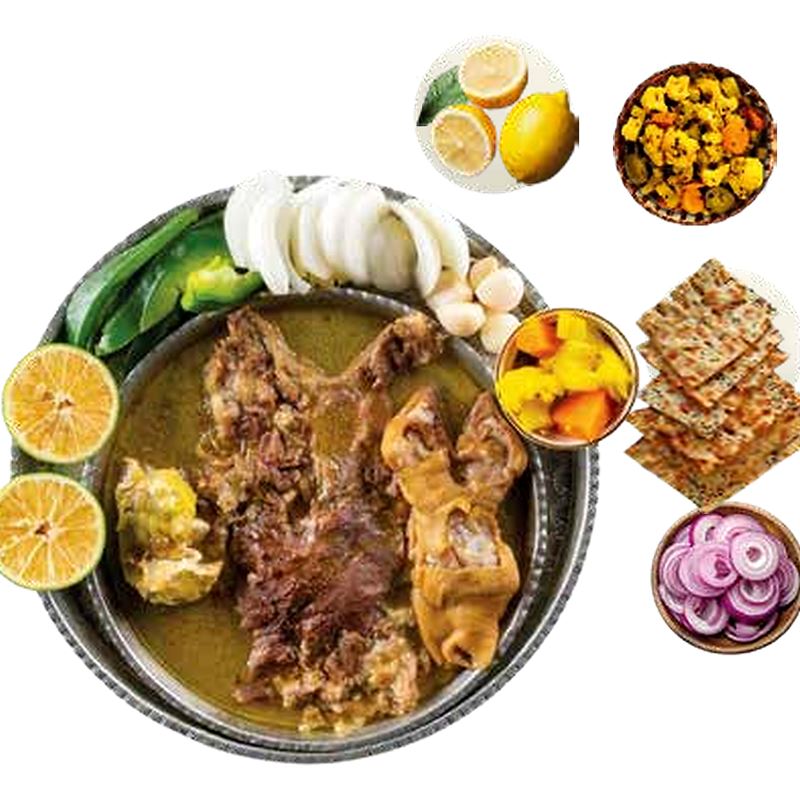
The Omelette on our menu is a Persian breakfast plate of eggs, and it sits on a kalle pache menu for one plain reason: not everyone who comes to that table eats offal. Add it whenever you are feeding a group and at least one person needs a plate of their own beside the broth — a child, a cautious first-timer, or someone who just wants something familiar.
This is a guide to ordering it, not to cooking it: who it is for, what to put beside it, and how to add it to an order at Shaun the Sheep so nobody at your table ends up holding a piece of bread and nothing else.
What is an Omelette doing on a kalle pache menu?
Kalle pache is a committed dish. The singles — Brain, Tongue, Trotters, Lamb Cheek, Eye, Tripe, Meat and the Special Mix — are for people who already know they love them. Soup and Brain Soup are gentler doors into the same room. But there is almost always one person at a weekend morning table who is not walking through any of those doors, and a spread with nothing on it for them is not really finished.
That is the job the Omelette does. It is the plate that completes the table: the same warm, savoury, bread-and-pickle kind of eating as everything else on the tray, but it asks nothing of the person eating it. They tear the same Sangak Bread, reach into the same Mixed Torshi, drink the same tea, and take part in the meal instead of politely watching it.
Who is it actually for?
Four people, roughly — and you probably know at least one of them.
- The one who does not eat offal. Not squeamish, not making a point — this simply is not their food. An Omelette costs you one extra line at checkout and buys you a guest who is eating rather than waiting.
- The child. Children at a kalle pache table usually want the bread, the pickles and the ritual far more than the bowl. An Omelette with Sangak Bread gives them a plate of their own inside a meal built for adults.
- The cautious first-timer. Order them a bowl of Soup to taste and an Omelette to fall back on, and the whole thing stops feeling like a gamble. If they want the background first, start with our primer on what kalle pache actually is.
- The one who wants breakfast, not an event. Someone is up early with somewhere to be and wants eggs, bread and tea while everyone else settles into the long version of the morning.
Who is at your table, and what should you order for them?
Read the table below as a seating plan rather than a menu. Go round person by person and the order more or less writes itself.
| Who is at the table | What to order for them | Why it works |
|---|---|---|
| Someone who does not eat offal | Omelette + Sangak Bread + Mixed Torshi | A complete plate that needs nothing from the shared bowls |
| A child | Omelette + Sangak Bread | Familiar, hot, and theirs; the bread does the rest |
| A cautious first-timer | Soup + Omelette | They taste the broth knowing there is a fallback |
| Curious, but wary of texture | Brain Soup or Soup + Omelette | The flavour without committing to a whole single |
| A confident eater | Special Mix, or a Single Dish | They came for exactly this; leave them to it |
| Two people who know what they want | Double Dish + one Omelette to share | The omelette becomes a side rather than a rescue |
| A whole family, or a group of six | The Khan's Platter + one or two Omelettes | The platter feeds the believers; the omelettes cover the rest |
The Khan's Platter is the clearest case. It arrives as four lamb cheeks, eight trotters, two brains, three tongues, four eyes and five breads — an order aimed squarely at people who love this food. An Omelette or two alongside it turns a feast for the enthusiasts into a meal for the whole family. There is more on it in our Khan's Platter guide.
How does it fit into a shared spread?
Persian breakfast is a table, not a sequence of courses. Everything lands at once and everyone reaches, which is exactly why the Omelette works here: it interrupts nothing.
Order enough Sangak Bread for the whole table; it is the utensil as much as the side, and the Special Sangak is worth adding when you are feeding people properly. Mixed Torshi and Garlic Torshi both cut through the broth and the eggs, the garlic one being sharper. For drinks, fresh Lemonade and Doogh suit the table, and tea is the traditional close. One thing to know first: the Kettle of Tea is dine-in only and cannot be delivered, so if the order is going home, choose Tea or Black Tea.
Then there are the extras. Capsicum, Onion, Fresh Chili, Pickled Green Chili and extra Sangak are their own separately orderable rows on the menu — add-ons you tick alongside a dish, not things that turn up automatically. If you want raw onion on the table or a fresh chili beside the omelette, add them on purpose.
Is the Omelette only a breakfast order?
It is a breakfast dish by temperament, but the kitchen is open twenty-four hours a day, every day, so the clock is not the constraint. And if you want it for a particular morning, the website takes scheduled orders: pick a future time up to about two days ahead and the kitchen holds it for that slot — the easiest way to have breakfast arrive while everyone is still around the table.
How do you actually add it to an order?
On the Shaun the Sheep website, in English, Arabic or Farsi. The site is trilingual with a language switcher, and your language carries through the menu, the checkout and the order page, with dish names shown in it. The choice is remembered on that device, so you pick once.
The rest is short.
- Choose delivery, pickup or dine-in — a table can be reserved for dine-in.
- Add your singles or your platter, then the Omelette as its own item, and tick any extras alongside it.
- There is no account and no sign-up. Your name and phone number are enough; for delivery you also choose your Dubai area from the list and drop a map pin, both required. For pickup, neither is needed.
- Pay by secure online card payment at checkout — that is how orders are placed.
- Delivery is free over AED 300.
After payment the kitchen confirms the order and sets an estimated time. The order gets its own page you can keep open and follow, and the rider phones you when he arrives. If the kitchen cannot fulfil an order, it is refunded automatically to the card that paid, with the reason shown on that page. And if you need to change something after ordering — add the Omelette you forgot, swap a bowl — phone the kitchen on 04 321 8882. That number is our only contact channel.
What about spice, or a question about a specific dish?
Ask us on the phone before you order. Pickled Green Chili and Fresh Chili are add-ons precisely so heat is a choice, not a default, but if anyone at your table has an allergy or needs to know exactly what is in a dish, call 04 321 8882 and ask the kitchen directly. We cannot make promises about cross-contact in a working kitchen, so please tell us before you order, not after.
One plain note: nothing here is medical advice. If you have a health condition, an allergy or a dietary restriction, speak to your doctor.
So when should you add it?
Whenever the number of people at the table is larger than the number of people who eat offal. That is the whole rule. One Omelette turns a table where somebody is politely picking at bread into a table where everyone is eating.
Open the menu on the Shaun the Sheep homepage, build the order around the people rather than the dishes, and add the Omelette for whoever needs it. We are at 64 Jumeira Street, Jumeirah 1, and we deliver across Dubai around the clock. Questions before you order: 04 321 8882.
