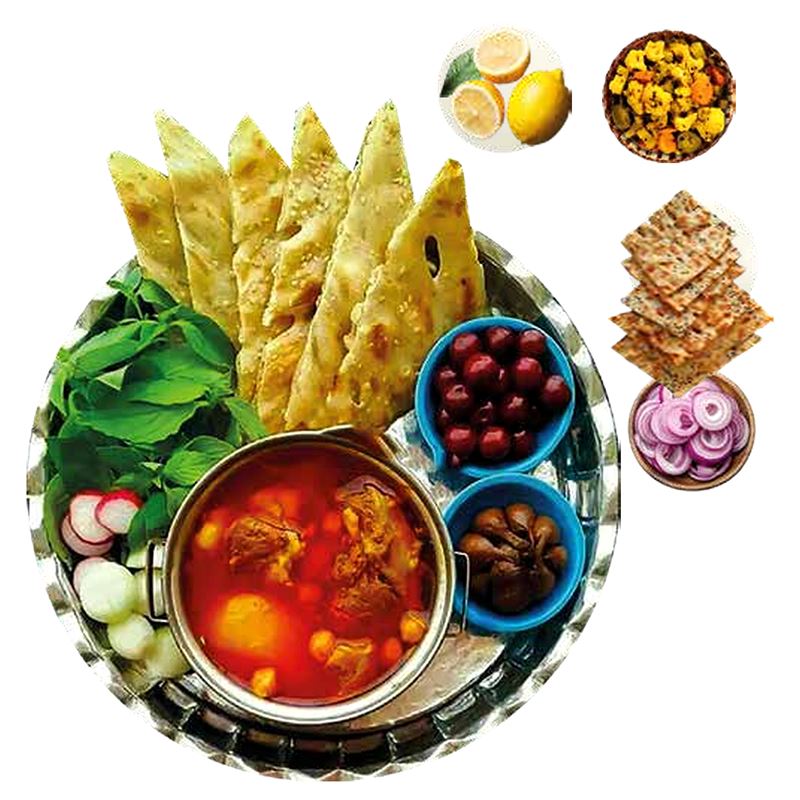
What is abgoosht, the Persian dish also known as dizi?
Abgoosht is one of Iran's oldest and most comforting home-cooked meals: a slow-simmered stew of lamb on the bone, chickpeas, white beans, potato, tomato and dried lime, all turned a warm gold by turmeric. The name is a simple compound — aab (water) and goosht (meat) — and it hints at the dish's clever double life on the table, which we will come to shortly. Across Iran it is the food of unhurried lunches, of families gathered around a sofreh, and of tea-house afternoons where a single earthen pot can fill one hungry person completely. If the only Persian lamb dish you know is kalle pache, think of abgoosht as its heartier, more everyday cousin.
What goes into a dizi: lamb, chickpeas, beans, potato and dried lime?
The beauty of abgoosht is its honesty. There are no shortcuts and no luxuries — just a handful of humble ingredients given hours of gentle heat. A classic pot holds:
- Lamb on the bone — usually shank or neck, so the marrow and connective tissue melt slowly into the broth.
- Chickpeas and white beans — soaked overnight, they thicken the stew and carry its flavour.
- Potato and onion — for body and a soft, sweet backbone.
- Tomato — fresh, as paste, or both, for colour and a little acidity.
- Dried lime (limoo amani), turmeric, salt and pepper — the seasoning that makes it unmistakably Persian.
Why does dried lime matter so much?
Pierced and dropped in whole, limoo amani releases a dark, tangy, almost smoky sourness as it softens. It is the note that keeps a rich lamb stew from feeling heavy, cutting through the fat and giving each spoonful its lift. Many Iranians will tell you a dizi without dried lime is simply not a dizi.
Why is abgoosht called dizi, and what is the pot made of?
The dish borrows its nickname from the vessel it is cooked and served in. A dizi is a small, narrow-necked crock — traditionally carved from soapstone (sang) or fired from clay, and today often a sturdy metal version — that holds heat beautifully and lets the flavours settle and concentrate. Each diner usually gets their own single-serving dizi, brought to the table still steaming. That narrow neck is not just decoration: it is exactly what makes the eating ritual work.
How do you actually eat abgoosht? The famous two-part ritual
This is where abgoosht becomes an experience rather than just a meal. You do not simply dig in; the dish is eaten in two deliberate acts.
First: drink the broth with torn sangak
You tilt the pot and pour the thin, fragrant broth into a waiting bowl, then tear fresh sangak bread into small pieces and drop them in until they soak up the liquid. This soft, savoury bread-soup — a kind of tilit — is the first course, sipped and spooned while it is piping hot.
Then: mash the solids into goosht-koobideh
Left in the pot are the meat, chickpeas, beans and potato. Using a goosht-koob — a heavy pestle or masher — you pound everything into a smooth, spreadable paste called goosht-koobideh. This is the second course: scooped onto more sangak and eaten with raw onion, fresh herbs and a bite of torshi or seven-year garlic pickle. One pot, two completely different textures — that is the genius of dizi.
How is abgoosht different from kalle pache?
They are both slow-cooked Persian lamb dishes served with sangak, but they are not the same animal — quite literally. Here is a quick comparison:
| Feature | Abgoosht (Dizi) | Kalle Pache |
|---|---|---|
| Main ingredients | Lamb on the bone, chickpeas, white beans, potato | Lamb head and trotters |
| Texture | Thick stew you mash into a paste | Clear, silky, collagen-rich broth |
| Cooking vessel | Stone, clay or metal crock (dizi) | Large copper pot |
| The ritual | Broth first, then mash the solids yourself | Spooned over bread with lime and garlic |
| Usual time | Lunch or dinner | Dawn or late night |
| Feel | Filling and rustic | Rich and restorative |
When do Iranians eat abgoosht?
Unlike kalle pache, which belongs to the dawn and the small hours, abgoosht is a daytime dish — most often a leisurely lunch, especially on cold days and in winter, when its warmth and heft are most welcome. It is classic tea-house and worker's fare: filling, affordable and endlessly satisfying. It is also a natural choice for guests, because the mashing ritual turns an ordinary meal into something shared and a little theatrical. At Shaun the Sheep, though, you do not have to wait for a particular hour — we are open around the clock.
Where can you eat abgoosht (dizi) in Dubai?
Shaun the Sheep is a Tehran-style kitchen at 64 Jumeira Street, Jumeirah 1 — a single kitchen, not a chain, that cooks its lamb the slow way and delivers right across Dubai. We are open 24 hours a day, seven days a week, and our lamb is halal, as UAE law requires. Alongside our abgoosht/dizi you will find plain and brain soups; singles like trotters (paye), tongue (zaban), brain (maghz), lamb cheek (bonagoosh), meat and tripe (sirabi); a Special Mix; and sides of sangak, mixed torshi and doogh. Order for delivery to any of Dubai's areas — free on orders over AED 300 — or choose pickup, dine-in, or schedule your order for later. Browse the menu and order page to start, or reserve a table if you would rather gather around the pot with us.
This article is about culinary tradition, not medical or nutritional advice. If you have specific dietary concerns, please consult your doctor.
